Émile Durkheim 

Presented by

CHEN Chak Yan
|
LAI Hei Laam
|
LAM Yan Lok
|
LIANG Wing Yi
|
LIAO Pong Wun
|
MOK Tang Han

Emile Dukheim was a French sociologist in the late 19th and 20th century (1858-1917), who was the establisher of sociology as an academic discipline. He was also well-known for theories such as functionalism, division of labor, anomy, solidarity, social integration and so forth (Carls, 2025).

In this story map, we are going to delve into how his life story and different locations exert influence on his works, such as The Division of Labor in Society (1893), The Rules of Sociological Method (1895), Suicide (1897), The Elementary Forms of Religious Life (1912), Education and Sociology (1922) and Moral Education (1925). In the follwing, the timeline will reveal the important events of Durkheim’s life. As for locations’ influence on his works, you will have a glimpse of their impacts on Durkheim’s works and theoretical development in the map tour section.

share this story map:

Facebook
X
Telegram
WhatsApp
Threads
Email
Print

Here’s more

From Study and Critique to the Marxist Ideological Movement

Karl Marx (1818-1883). What will you think immediately about him? Communism, Revolution, or A big old man. As one of the most influential thinkers in modern history, Marx’s revolutionary ideas reshaped modern philosophy and created a new ideology. Marx has established a critical framework for understanding capitalist society, understanding history using materialism. He has introduced terms like dialectical materialism, class struggle, and exploitation and surplus value. His idea has lasted for centuries till now, influencing big nations like the USSR, China, Cuba, and Joseon. For such a great man, we should be very curious about his life. How can his childhood shape his contribution? What is he doing in his lifetime?

Read More

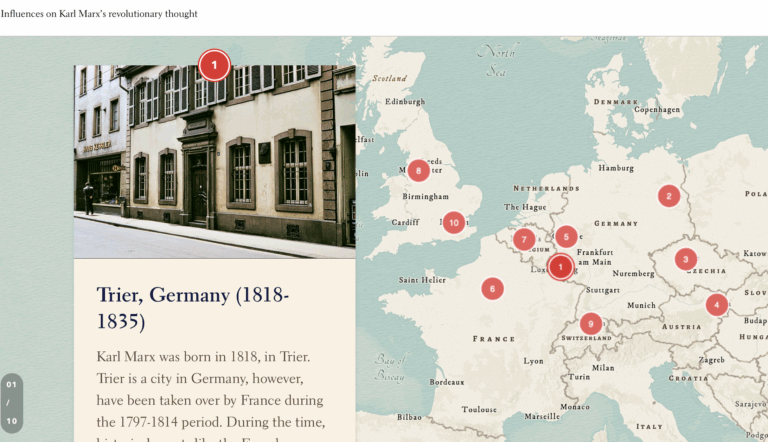
Influences on Karl Marx’s revolutionary thought

n this digital map, we aim to explore the life and ideas of Karl Marx, with a specific focus on ten locations which are closely related to Marx’s work. The locations include Trier, Berlin, Prague, Vienna, Cologne, Paris, Brussels, Manchester, Switzerland and London.

Read More