Educational Traces of Emile Durkheim

Presented by

GUAN Ka Man
|
HUANG Tsz Ying
|
KAM Tsoi Lam
|
LAM Hoi Ting
|
TANG Tsun Ting
|
TSE Hiu Ying

Émile Durkheim (1858–1917) is widely regarded as one of the founders of sociology. His texts established the cornerstone for the scientific examination of society with a focus on social organization, common norms, and empiricism. 

This digital theorist map explores how Durkheim’s own life experiences (from the battle-scarred landscapes of Lorraine to the university corridors of Paris) shaped his revolutionary ideas. Each environment left its mark on his ideas, translating individual and historical conflicts into universal sociological models.
Here’s more

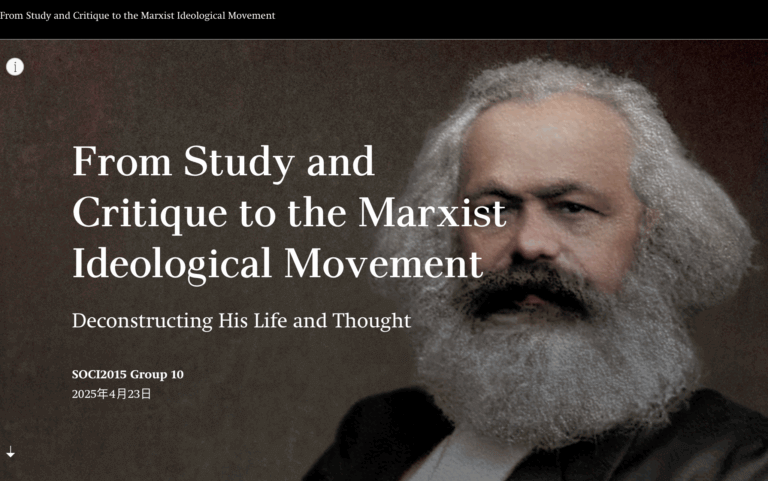
From Study and Critique to the Marxist Ideological Movement

Karl Marx (1818-1883). What will you think immediately about him? Communism, Revolution, or A big old man. As one of the most influential thinkers in modern history, Marx’s revolutionary ideas reshaped modern philosophy and created a new ideology. Marx has established a critical framework for understanding capitalist society, understanding history using materialism. He has introduced terms like dialectical materialism, class struggle, and exploitation and surplus value. His idea has lasted for centuries till now, influencing big nations like the USSR, China, Cuba, and Joseon. For such a great man, we should be very curious about his life. How can his childhood shape his contribution? What is he doing in his lifetime?

Read More

Influences on Karl Marx’s revolutionary thought

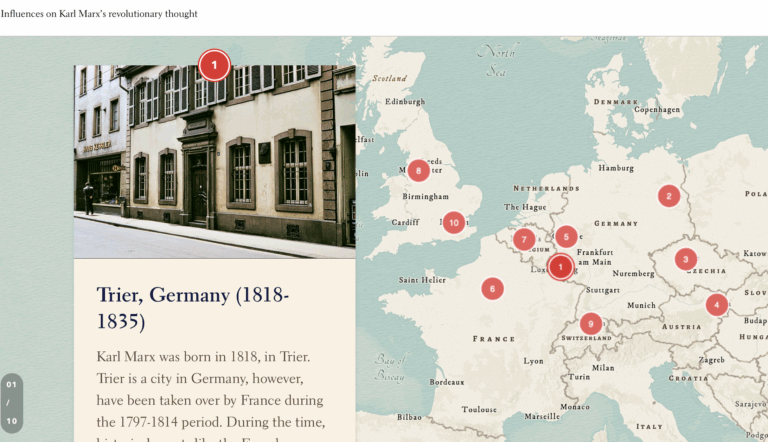
n this digital map, we aim to explore the life and ideas of Karl Marx, with a specific focus on ten locations which are closely related to Marx’s work. The locations include Trier, Berlin, Prague, Vienna, Cologne, Paris, Brussels, Manchester, Switzerland and London.

Read More