Emile Durkheim

Presented by

IMASHEVA Dilnaz
|
KONG Yu Hin
|
LIU Yifan
|
TSANG Wing Chi
|
YEUNG Ging Hao
|
YU Ka Yi

How the change of French society impacted on development of Durkheim’s theories

Émile Durkheim (1858–1917) lived during a period of profound transformation in Europe. The Industrial Revolution accelerated social transformation. As a result, rapid urbanization and industrialization dismantled traditional agrarian societies, while intensified social division of labor and class conflicts. In France, after the defeat in the Franco-Prussian War and the upheaval of the Paris Commune,  the Third Republic was established, where secularism and scientific rationality started to spread and gradually replaced religious authority.  This social disorder, moral crises, and the rise of individualism become the major issues discussed by scholars in this period.  Durkheim’s scholarship emerged from this turmoil period, seeking to answer the question: “How can modern society maintain integration and stability?”   Influenced by the trend of positivism that introduced natural scientific methods to the humanities, Durkheim advocated for the study of social phenomena through empirical methods, establishing sociology as an independent discipline.  His theories make an explanation for societal upheavals in this period while laying foundational methodologies for modern social science.
share this story map:

Facebook
X
Telegram
WhatsApp
Threads
Email
Print

Here’s more

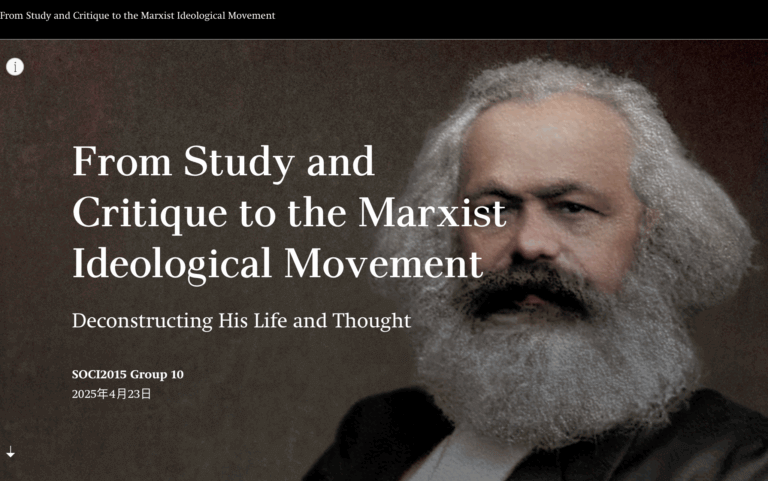
From Study and Critique to the Marxist Ideological Movement

Karl Marx (1818-1883). What will you think immediately about him? Communism, Revolution, or A big old man. As one of the most influential thinkers in modern history, Marx’s revolutionary ideas reshaped modern philosophy and created a new ideology. Marx has established a critical framework for understanding capitalist society, understanding history using materialism. He has introduced terms like dialectical materialism, class struggle, and exploitation and surplus value. His idea has lasted for centuries till now, influencing big nations like the USSR, China, Cuba, and Joseon. For such a great man, we should be very curious about his life. How can his childhood shape his contribution? What is he doing in his lifetime?

Read More

Influences on Karl Marx’s revolutionary thought

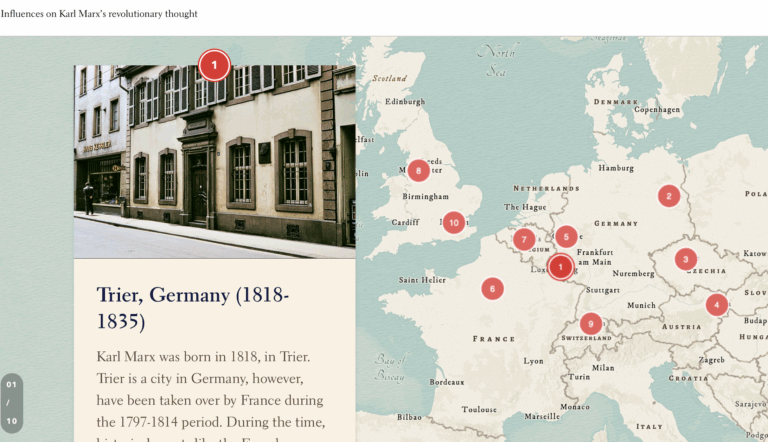
n this digital map, we aim to explore the life and ideas of Karl Marx, with a specific focus on ten locations which are closely related to Marx’s work. The locations include Trier, Berlin, Prague, Vienna, Cologne, Paris, Brussels, Manchester, Switzerland and London.

Read More